Fifteen Scaled Worm
Author: Charlotte Read
Scientific name: Harmothoe imbricata
Size range: ~25mm (1 inch)
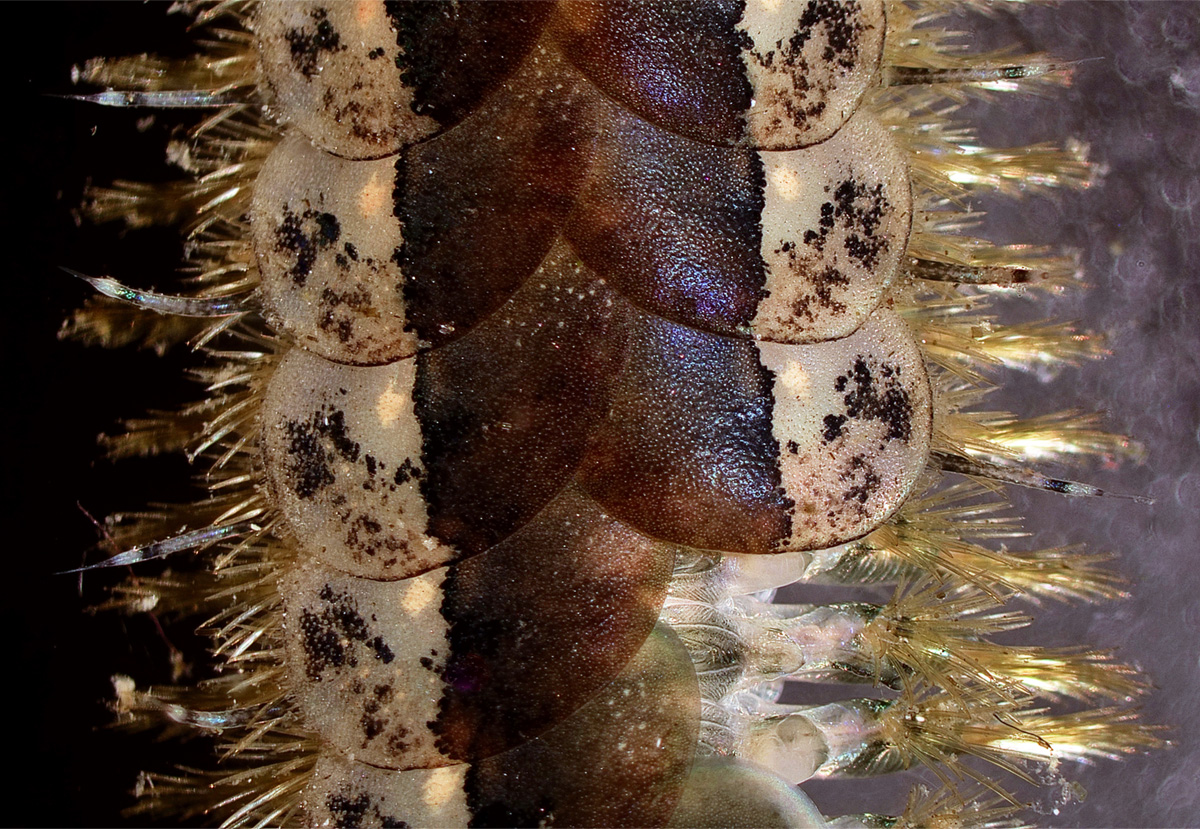
Identifying Features: Fifteen-scaled worms are dorsoventrally flattened, meaning their bodies are compressed from top to bottom. Covering the majority of their body are 15 pairs of overlapping scales called elytra. These scales have a pattern and are usually a shade of brown or grey to help it blend in with underwater rocky environments. Flaring out around the edges of the scales are the notosetae and neurosetae, these make up the “Bristles” you can see on the sides.
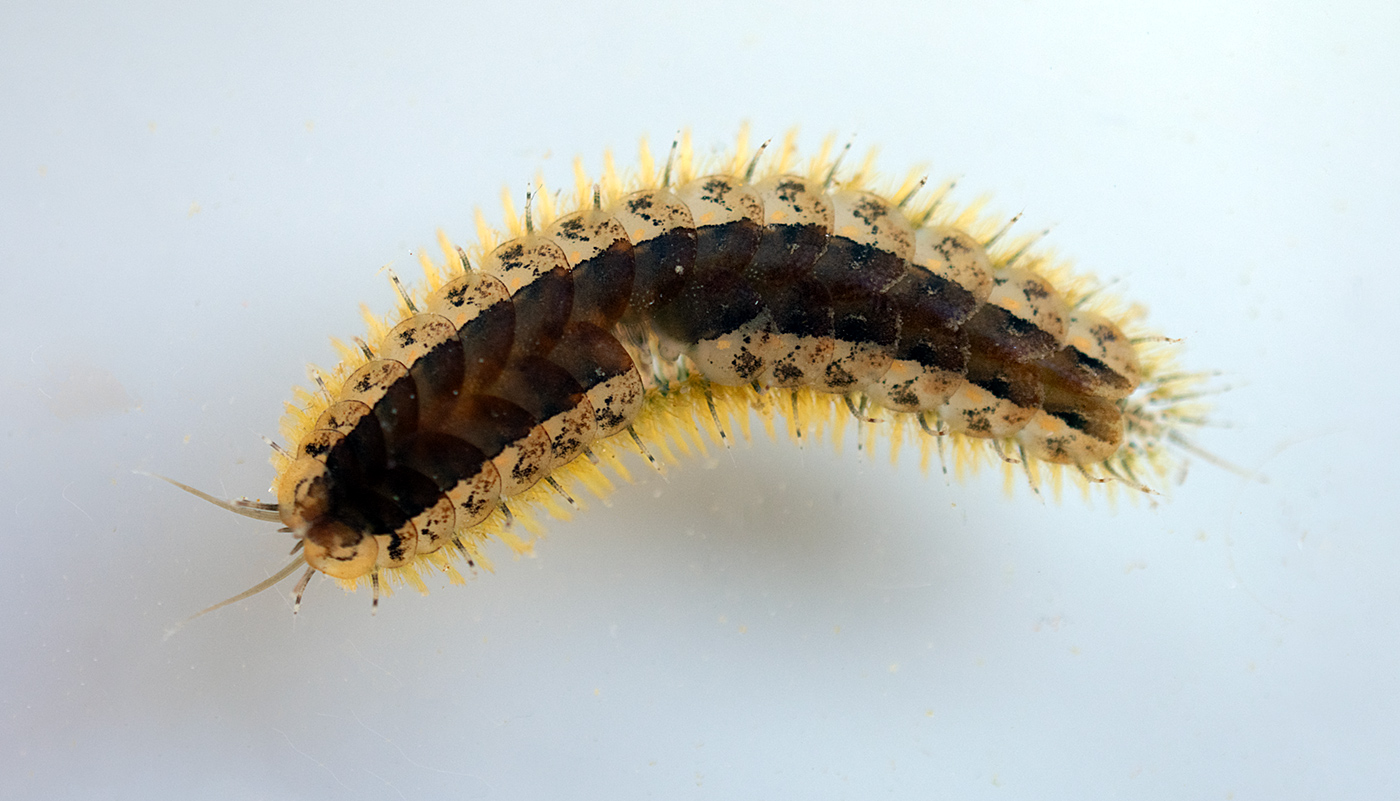
This particular Fifteen-scaled worm has lost two of its scales.
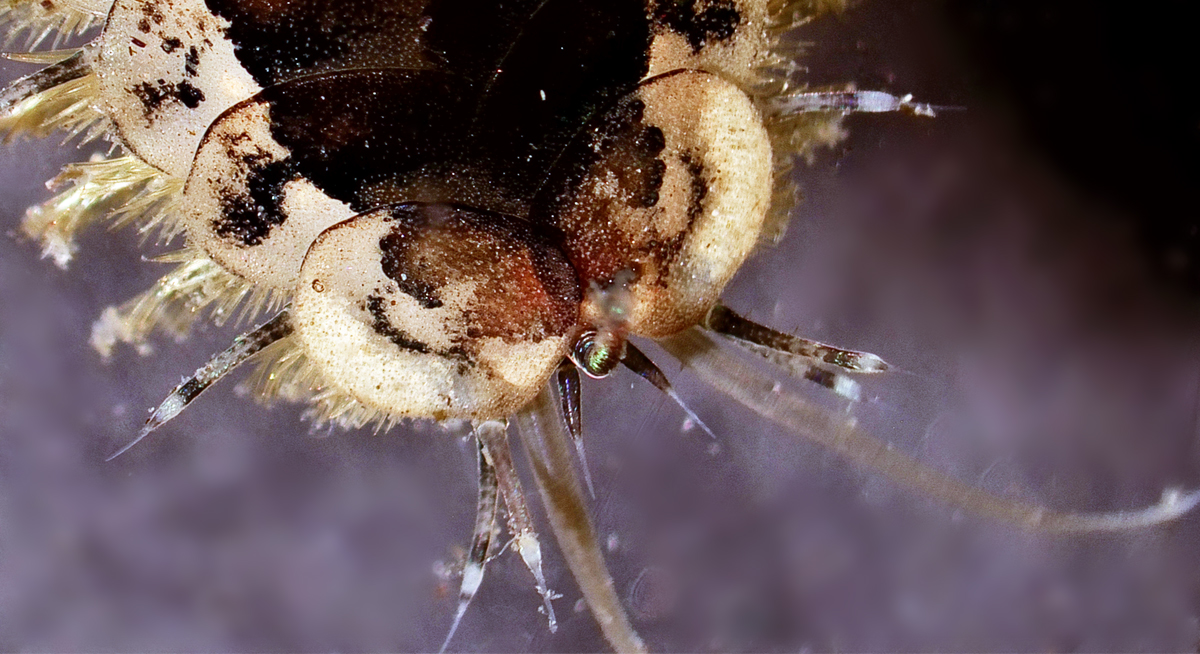
The head of a Fifteen-scaled worm
The notosetae and neurosetae help with locomotion and anchoring the worm. Visible from above unless covered by the elytra, the Fifteen-scaled worm has a pair of eyes. They also have another pair of eyes that are only visible from the side of the worm.
Habitat: Fifteen-scaled worms have been found living in oceans throughout much of the northern hemisphere, along the Pacific coast from Alaska to California, in the Indo-pacific and Atlantic Oceans as well as the Arctic and Mediterranean Seas. They are most commonly located hiding on the rocks in the tidepools at low tide (intertidal zone). They have been found as deep as 3710m.
Food (Prey): Scale worms tend to feed mostly on small invertebrates such as crustaceans, amphipods, mollusks, snails and other polychaetes. Fifteen-scaled worms eat using a jawed pharynx located in the throat. These jaws have a row of teeth on the top and bottom to allow for chewing.
Predators and Defense : Fifteen-scaled worm are eaten mostly by larger invertebrates like crabs, sea spiders and other worms. Perhaps the most obvious defence mechanism of Fifteen-scaled worms are their scales. The elytra act as a shield against predators to protect the worm from serious injury. Another way for Scale worms to defend themselves is to blend into their surroundings. Due to their colour and patterns, they are able to hide against rocks, making them hard to see.
Life Cycle : When female Fifteen-scaled worms are ready to mate, they produce a pheromone that is released into the water that attracts males and lets them know to release their sperm. This signals the female to release her eggs. This type of reproduction is called swarming. After fertilization of the egg, it develops into a trochophore larvae, from here, the worm continues to grow until it reaches the juvenile stage and then on to a fully grown adult.
Fun Facts :
- Fifteen-scaled worms belong to the family Polynoidae.
- Fifteen-scaled worms are very fast moving.
- Fifteen-scaled worms are part of the class Polychaeta which means “many bristles”.
Photos by Charlotte Read
References:
Online Citations:
Benko, Raven Capone. “Adaptation in the Extremes: What Scale Worms Teach Us about Evolution.” Si.edu, 30 Oct. 2024, ocean.si.edu/ocean-life/invertebrates/adaptation-extremes-what-scale-worms-teach-us-about-evolution.
Cowles, Dave. “Harmothoe Imbricata.” Wallawalla.edu, 2025, inverts.wallawalla.edu/Annelida/Polynoidae/Harmothoe_imbricata.html.
“Fifteen-Scaled Worm (Common Marine Invertebrates of Lake Merritt) · INaturalist.” INaturalist, 2015, www.inaturalist.org/guide_taxa/46734.
Ross, Heather. “Antarctic Scale Worm.” A-Z Animals, 16 Sept. 2021, a-z-animals.com/animals/antarctic-scale-worm/#single-animal-text. Accessed 28 Jan. 2026.
“Scale Worm | Segmented Body, Bristles, Setae | Britannica.” Www.britannica.com, www.britannica.com/animal/scale-worm.
Worm, Fifteen-Scaled. “Gulf of Maine, Inc.” Gulf of Maine, Inc., 2019, gulfofme.com/all-sea-life/p/p/15-scaled-worm-harmothoe. Accessed 28 Jan. 2026.