
Plainfin Midshipman
Author: Aidan Fudge
Photos by Janna Nichols (https://www.pnwscuba.com/)
Scientific name: Porichthys notatus
Size range in length: 9.6-16.2 cm (females), 6.5-21cm (males)
Identifying features: The bodies of Porichthys notatus are long and flat with colour ranging from brown to olive. They also have wide pectoral fins, protuberant eyes, a long tail, and a series of fringe-like rays along their spine. They have lines of photophores on their underbelly and sides, which resemble the lines found on a Midshipman’s naval uniform. This earned them the name Midshipman. They are sexually dimorphic, and also vary in size between the two different male morphs: guarders and sneakers, with guarders being roughly seven times larger.
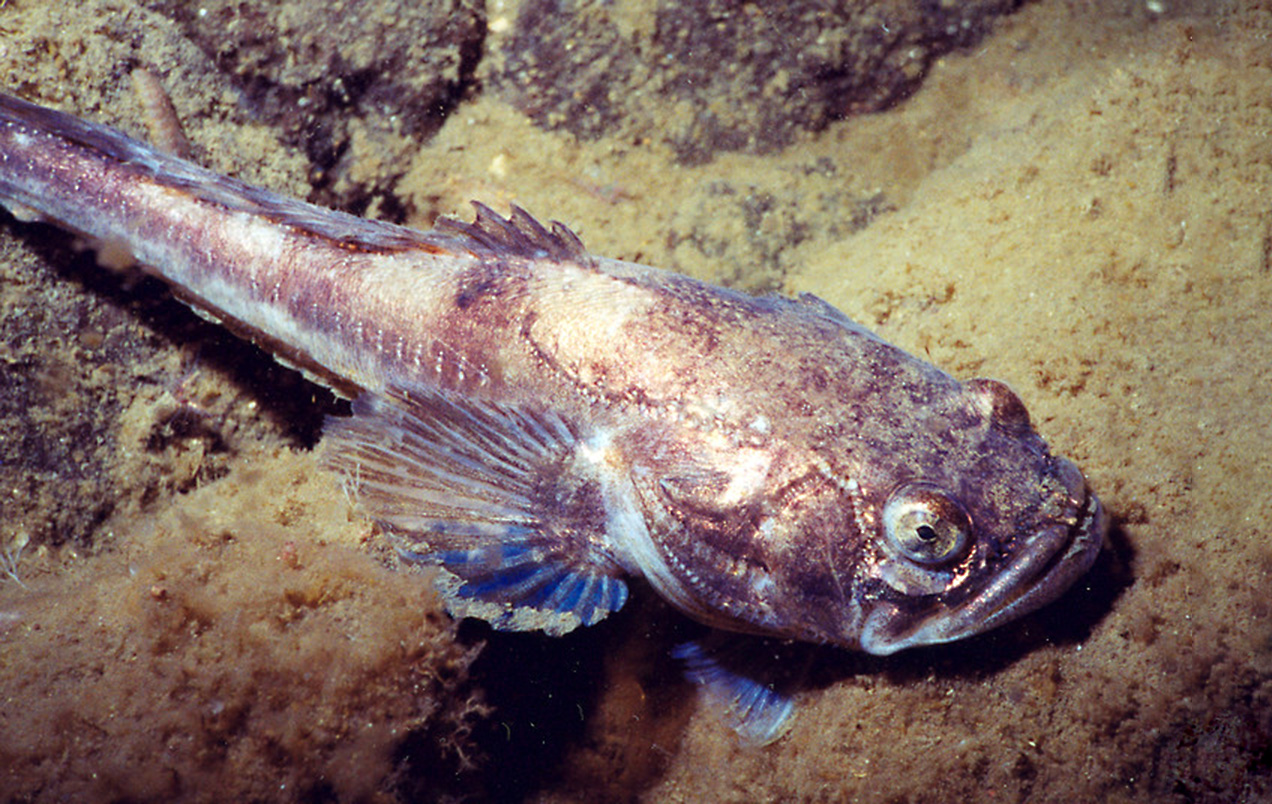
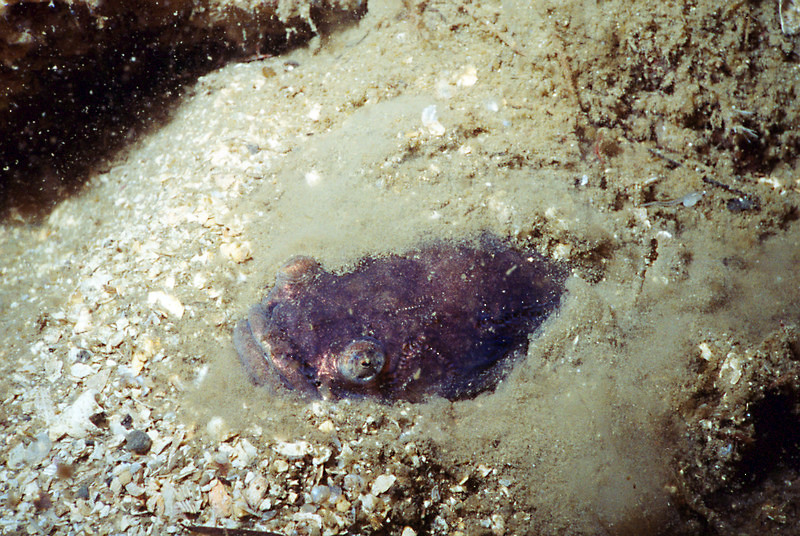
Habitat: Porichthys notatus can be found all over the west coast of North America, from Alaska to as far south as Mexico. They spend half the year on the sandy seafloor in benthic regions, over 300 m down. During spring and summer, the midshipman returns to the intertidal zone to breed, as they have evolved to survive its treacherous conditions. They dig hollow burrows under rocks to use as nests.
Prey: The Plainfin Midshipman is carnivorous, mainly feeding on small fish and crustaceans. It is theorized that the midshipman obtains the luciferin used to illuminate its photophores by eating the luminescent crustacean Vargula hilgendorfii or one of its relatives. The midshipman is an ambush hunter, so it hunts by staying totally still, blending in with the sand and rocks, waiting for prey to come into range of their strike.
Predators: When on the seafloor, Porichthys notatus is most often food to larger marine mammals and fish, such as sharks and seals, whereas during the breeding season, they’re more vulnerable to threats from above. Birds, such as gulls, herons, and crows all prey on nesting midshipmans in the intertidal zone, and Bald Eagles are a particularly common predator. However, juvenile midshipmans have a way to hide from avian threats. The photophores of juveniles point ventrally; this downward facing light creates a silhouette around the fish, obscuring them from a predators’ view.
Life Cycle: After returning to shallow waters during the warm seasons, the male Plainfin Midshipman will dig itself a nest in the sand, usually under the protection of rocks, and will await a potential mate to lay their eggs in the burrow. Type 1 males, or “guarders,” will attract females by generating a low, resonant “humming” sound. This can often be so loud and droning that it will be heard by humans in quiet areas. When multiple Midshipmans sing together, it is often described as sounding like a swarm of bees.
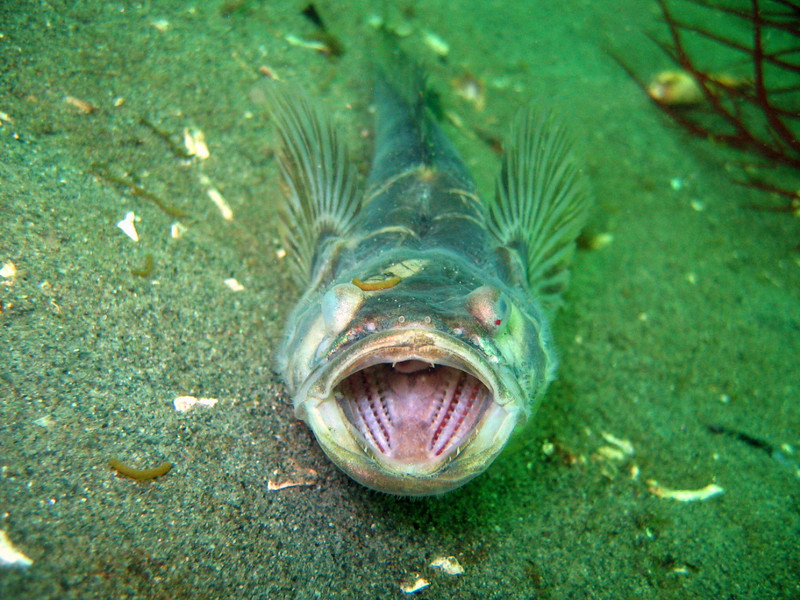
They can also alter their hearing to block out their own sound, preventing ear damage from the noise. Alternatively, Type 2 males, or “sneakers,” don’t have the same acoustic abilities. Sneakers will sneakily wait for a female to enter a guarder’s nest, then quickly swim into the nest and fertilize as many eggs as possible before the guarder can.
Fun Facts:
- The Midshipman can breathe air outside of water; it is one of the only fish on earth with this skill.
- In the summer of 1981, houseboat residents in Sausalito, California began to notice humming sounds in the night, varying in volume. After several years, the sound had become intolerable, interrupting conversations and preventing sleep, especially for households that extended below the water line. Conspiracy theories about the origin of the noise were spread, from military experiments to alien activity, but Ichthyologist John E. McCosker eventually traced the sound to its source: the Plainfin Midshipman’s song. After the discovery, the residents of Sausalito decided to celebrate their local singing fish with the Humming Toadfish Festival, which became an annual event drawing hundreds of tourists to the town, and continued until 1990.
References
Brantley, R. K., & Bass, A. H. (1994). Alternative Male Spawning Tactics and Acoustic Signals in the Plainfin Midshipman Fish Porichthys notatus Girard (Teleostei, Batrachoididae). Ethology: International Journal of Behavioral Biology, 96(3), 213-232. https://onlinelibrary.wiley.com/doi/10.1111/j.1439-0310.1994.tb01011.x
Clinton, L. (2019, March 27). The Humming Toadfish Festival. Sausalito Historical Society. https://www.sausalitohistoricalsociety.com/2019-columns/2019/3/27/the-humming-toadfish-festival
Cullis-Suzuki, S. (2016). Singing Fish in an Ocean of Noise: Effects of Boat Noise on the Plainfin Midshipman (Porichthys notatus) in a Natural Ecosystem. In Advances in Experimental Medicine and Biology (pp. 171-179). Springer Nature. 10.1007/978-1-4939-2981-8_20
Elliott, K. H., Struik, C. L., & Elliott, J. E. (n.d.). Bald Eagles ,Haliaeetusleucocephalus, Feedingon Spawning Plainf inMidshipman,Porichthysnotatus, at Cre scent Beach,Bri tish Colu. The Canadian Field-Natualist, 117(4), 601-604. https://doi.org/10.22621/cfn.v117i4.829
Harper, R. D., & Case, J. F. (1999). Disruptive counterillumination and its anti-predatory value in the plainfish midshipman Porichthys notatus. Marine Biology International Journal on Life in Oceans and Coastal Waters, 134, 529-540. Springer Nature Link. https://doi.org/10.1007/s002270050568
McMaster University. (n.d.). Plainfin midshipman. Aquatic Behavioural Ecology Laboratory. https://abel.mcmaster.ca/research/plainfin-Midshipman
Sea Wonder: Plainfin Midshipman. (2022, February 11). National Marine Sanctuary Foundation. https://marinesanctuary.org/blog/sea-wonder-plainfin-midshipman/